Class 12
Created by Titas Mallick
Biology Teacher • M.Sc. Botany • B.Ed. • CTET (CBSE) • CISCE Examiner
 BioNotes
Created by Titas Mallick
Biology Teacher • M.Sc. Botany • B.Ed. • CTET (CBSE) • CISCE Examiner
Online
Common Misconceptions
Watch Out! Advanced genetics breaks the simple rules you learned earlier:
Gregor Johann Mendel (1822-1884), known as the "Father of Genetics," conducted hybridization experiments on garden peas (Pisum sativum) for seven years (1856-1863) and proposed the laws of inheritance.
Monohybrid Cross: A cross involving a single pair of contrasting characters.
Dihybrid Cross: A cross involving two pairs of contrasting characters.
Back Cross: A cross between an F1 hybrid and either of its parents.
Test Cross: A cross between an F1 hybrid and its recessive parent. It is used to determine the genotype of an individual showing the dominant phenotype (whether it is homozygous dominant or heterozygous).
Punnett Square: A graphical representation to calculate the probability of all possible genotypes and phenotypes of offspring in a genetic cross. Developed by Reginald C. Punnett.
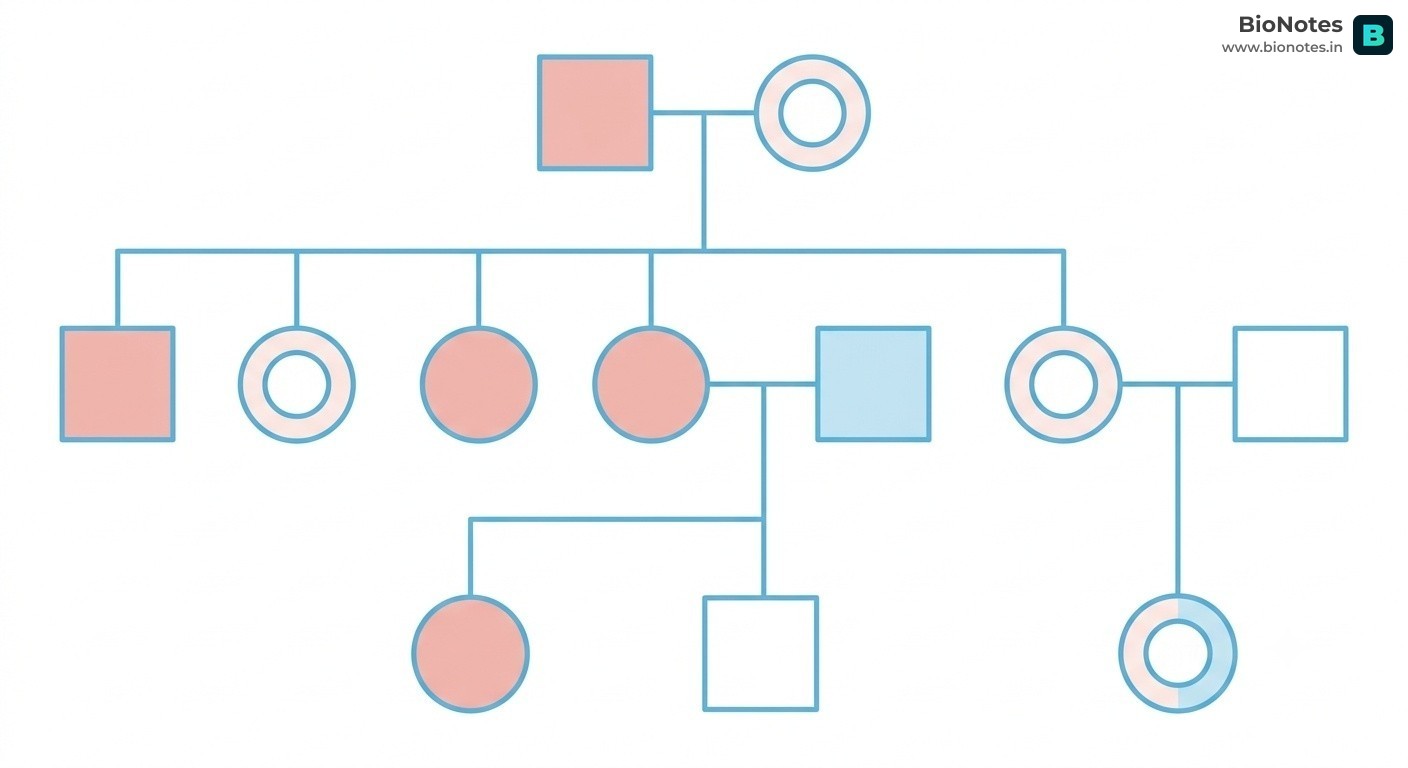
The Pink Miracle In Snapdragon plants, a cross between a Red (RR) and a White (rr) flower produces Pink (Rr) offspring. This is because the red pigment isn't strong enough to completely mask the white, leading to a visible "blend" of traits.
Codominance:
Multiple Alleles:
Polygenic Inheritance:
Pleiotropy:
Competitive Edge: Pleiotropy vs. Polygenic Inheritance Don't mix these up!
 www.bionotes.in
 www.bionotes.in
Inheritance of traits controlled by genes located on the sex chromosomes (allosomes):
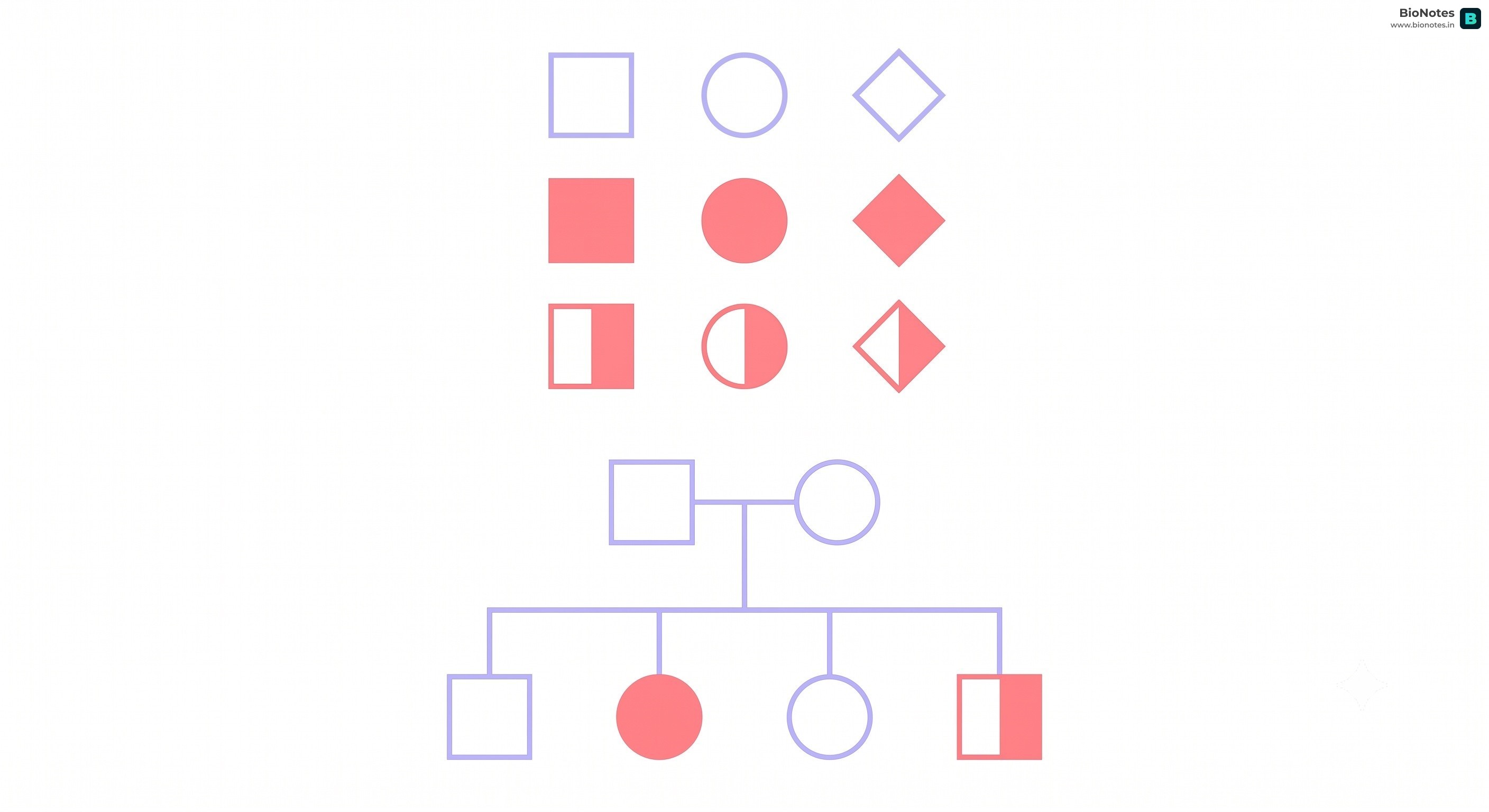
Mendelian disorders are genetic conditions caused by a mutation or alteration in a single gene. They follow strict Mendelian inheritance patterns and can be traced through family pedigrees:
| Feature | Sickle-Cell Anaemia | Thalassemia |
|---|---|---|
| Defect Category | Qualitative defect (synthesizes an abnormal, mutant globin molecule) | Quantitative defect (synthesizes too few or no normal globin chains) |
| Mutational Cause | Single point mutation () substituting Glu Val at position 6 | Deletions or point mutations reducing transcription or translation of globin genes |
| Globin Chain Involved | Strictly the -globin chain | Can involve -globin chain (chromosome 16) or -globin chain (chromosome 11) |
| RBC Morphology | Elongated, rigid, sickle-shaped RBCs under low | Microcytic (abnormally small) and hypochromic (pale) RBCs |
| Malaria Resistance | Confers significant resistance in heterozygous state () | Partial resistance observed in heterozygous states |
Chromosomal disorders are caused by the absence, excess, or abnormal numerical arrangement of one or more whole chromosomes. They arise due to non-disjunction (the failure of paired homologous chromosomes or sister chromatids to disjoin during meiotic cell division), producing gametes with abnormal chromosome numbers ( or ).
Competitive Edge: Aneuploidy vs. Polyploidy
Do not confuse these two chromosomal conditions:
| Feature | Mendelian Disorders | Chromosomal Disorders |
|---|---|---|
| Etiology (Cause) | Mutation / alteration in a single gene | Numerical or structural aberration of whole chromosomes |
| Inheritance Pattern | Follows strict Mendelian ratios; easily traced via pedigree analysis | Generally non-familial (accidental meiotic non-disjunction); does not follow Mendelian ratios |
| Karyotype Status | Normal karyotype (46 chromosomes; normal chromosomal banding) | Abnormal karyotype (, or altered chromosomal morphology) |
| Diagnostic Technique | DNA sequencing, PCR analysis, biochemical enzyme assays | Karyotyping, amniocentesis, fluorescence in situ hybridization (FISH) |
| Representative Examples | Sickle-cell anaemia, Thalassemia, Phenylketonuria, Haemophilia | Down's syndrome (47, +21), Turner's syndrome (45, XO), Klinefelter's syndrome (47, XXY) |
NGSS-HS-LS3-3AQA-ALevel-3.4.4IB-Biology-3.4